Red Seal Automotive Service Technician Exam Prep Guide
The Red Seal Automotive Service Technician exam is no longer a mechanical exam. On the current blueprint, electrical systems, vehicle networking and hybrid and electric vehicles account for 44 of the 125 questions. Engines and driveline together account for 39.
That single fact explains most of the failures. Technicians who have spent a decade doing brakes, timing belts and diagnostics on port injected engines walk in expecting the trade they know, and meet an exam built around the trade as it is practised nationally in 2026.
Automotive Service Technician has carried Red Seal designation since 1959 and is recognized in all thirteen provinces and territories. In Ontario it is trade 310S. Certification is compulsory in Ontario, Alberta, Nova Scotia, Prince Edward Island and New Brunswick, and voluntary elsewhere.
What Is the Red Seal Automotive Service Technician Exam?
It is the national certification exam for the trade, built from the Red Seal Occupational Standard, the document that describes what an Automotive Service Technician does across Canada rather than in any one shop or province.
In most jurisdictions this one exam does two jobs. Pass it and you receive your provincial Certificate of Qualification carrying the interprovincial Red Seal endorsement, which licensing bodies and employers accept nationwide.
The standard behind the current exam is the 2023 edition. It defines the trade as covering engines, vehicle management, steering, braking, tires, wheels, drivetrains and suspension. It also covers electrical systems, advanced driver assistance systems, electronics, HVAC, restraints, trim and accessories, on conventional, hybrid and electric vehicles.
Read that scope again before you decide you already know the material. Nobody works across all of it.
Who Can Write or Challenge the Red Seal Automotive Service Technician Exam?
Three routes lead to the exam. Which one applies depends on how you learned the trade and where you work.
Apprenticeship completion. Finish a registered apprenticeship, log the required hours, pass your in school levels, and your provincial authority clears you to write. The hour requirements differ by province. Ontario sets the program at 7,220 hours in total, made up of 6,500 hours on the job and 720 hours of in school training, roughly four years. British Columbia requires 6,360 hours of work based training plus four levels of 210 hours each. Alberta runs four twelve month periods with a minimum of 1,560 hours on the job and eight weeks of classroom instruction in each.
Work experience, the challenge route. Technicians who never registered as apprentices can apply to challenge the exam on documented experience. The bar is high and it is set provincially. British Columbia requires 9,540 documented hours in the occupation. Alberta's Trades Qualifier route requires 72 months and 9,180 hours of verifiable experience, a theory exam and a trades competency verification. Ontario handles this through a Trade Equivalency Assessment, which holds applicants to the same standard as an apprentice and requires experience at least equal to the full 7,220 hours, in school time included. That assessment costs $235 plus HST.
Internationally trained technicians. The same challenge pathways are open to technicians trained abroad, following a credential assessment. Authorities look at the breadth of your experience, not only the hour count, so a background concentrated in one area can trigger extra requirements before you are cleared to write. Start with the apprenticeship authority in the province where you intend to work, because processing times and documentation differ.
One Ontario detail worth knowing: apprentices who completed their program on or after 1 January 2025 get their first exam attempt free. Retakes cost $150 plus HST, and there is a mandatory 30 day wait before you can sit again.
Red Seal Automotive Service Technician Exam Format
| Factor | Details |
|---|---|
| Exam type | Multiple choice, four options, one correct answer |
| Questions | 125 |
| Passing score | 70% |
| Time limit | 4 hours |
| Working pace | About 1.9 minutes per question |
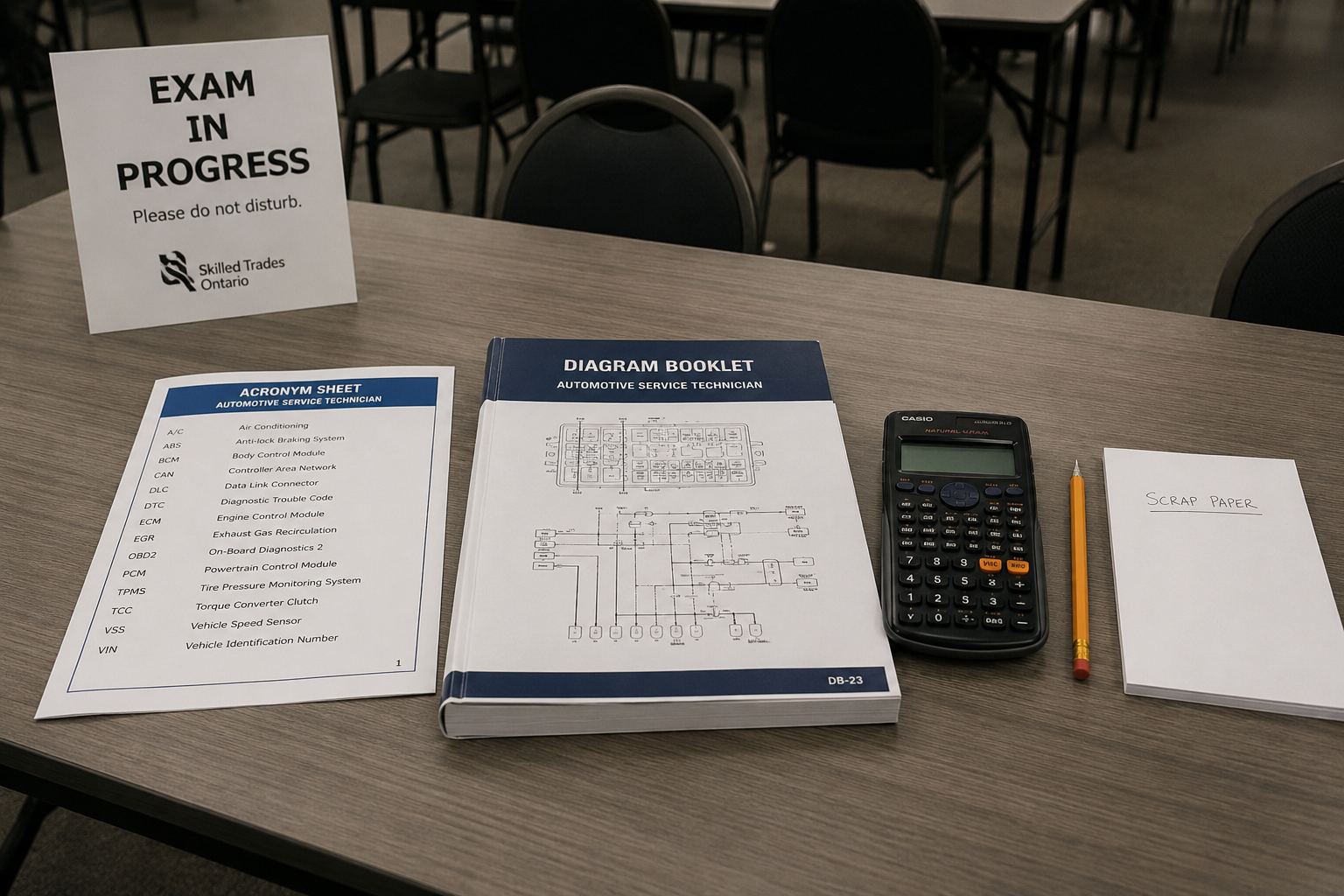
| Reference material | Closed book, acronym list supplied at the sitting |
Nothing about that table is generous. Four hours across 125 questions leaves under two minutes each, and the questions are not one line recall prompts. Many describe a vehicle, a symptom and a set of test results, then ask what you do next.
The acronym list is a genuine detail most candidates miss. Red Seal supplies the trade's acronyms at the exam sitting, more than a hundred of them, from DTC and PID to EHCU and VGT. You do not need to memorize the list. You do need to know what the systems behind those acronyms actually do.
Main Topics Covered on the Automotive Service Technician Red Seal Exam
Every question maps to a task in the occupational standard, and the distribution is published. Here is how the 125 questions fall.
| Major work activity | Questions |
|---|---|
| Electrical and comfort control systems | 23 |
| Steering, suspension, braking, tires, hubs, wheel bearings | 23 |
| Engine and engine support systems | 22 |
| Driveline systems | 17 |
| Vehicle module communications systems | 12 |
| Restraint systems, body components, accessories, trim | 10 |
| Common occupational skills | 9 |
| Hybrid and electric vehicle systems | 9 |
Two patterns matter more than the individual counts.
Diagnosis outweighs repair, heavily. Split every activity into its diagnostic tasks and its repair tasks and the exam divides 67 questions on diagnosis against 49 on repair. The single largest task on the paper is diagnosing steering, suspension, braking, tires and wheel bearings, at 13 questions. Knowing how to replace a component earns you fewer marks than knowing how to prove which component failed.
The electronic side of the trade is now the larger side. Electrical and comfort control at 23, module communications at 12 and hybrid and EV at 9 come to 44 questions. Engine and driveline come to 39. If CAN bus faults, high voltage isolation procedures and network topology are things you have avoided, that is 44 questions you are guessing at.
The question types confirm it. For this trade, 5 to 15% of questions test knowledge and recall, 40 to 50% test procedure and application, and 40 to 50% test critical thinking. At most 19 questions out of 125 reward memorizing a fact. The rest ask you to interpret data and reach a conclusion.
Red Seal revises these distributions periodically, and there is more than one version circulating online. Confirm the breakdown on the trade's official exam information page before you build a study plan around it.
Best Ways to Prepare for the Red Seal Automotive Service Technician Exam
Start with the occupational standard, not a study guide
Download the Red Seal Occupational Standard and the Trade Profile for the trade. Both are free. The standard lists every task and sub task the exam can assess, and the exam information page tells you how many questions sit on each one.
Run the free self assessment tool alongside it. It exists to show you where your experience does not match the national scope of the trade, which is exactly the gap that fails people. Be honest with it. A dealership technician who has been on a single manufacturer for eight years usually finds more gaps than expected.
Practise diagnosis as a sequence, not a guess
Given that 67 questions turn on diagnostic reasoning, this is where preparation pays. Work through faults the way the exam asks you to: what do the symptoms rule out, which systems are involved, what is the next test, and what would the result of that test prove.
Take a common example. A vehicle sets a lean code on one bank. The answer is not the part you replace most often. The exam wants the test that separates a vacuum leak from a fuel delivery problem from a sensor reporting incorrectly, and it wants it in the right order.
Close the electronics and EV gap deliberately
Forty four questions justify dedicated study time. Network topology and how modules communicate. Reading waveforms and live data rather than trusting a code. High voltage safety procedures, isolation and personal protective equipment. ADAS recalibration triggers and why a wheel alignment or a windshield replacement can require one.
Technicians from independent shops often have the mechanical side covered and this side thin. Technicians from dealerships often have the reverse problem on older systems and diesel support systems.
Use trade specific practice questions
Generic mechanic quizzes do not reflect the weighting or the reasoning style of a Red Seal paper. Practice material for this exam should mirror the published distribution, use four options with one defensible answer, and explain why the other three fail.
Run full length timed mock exams
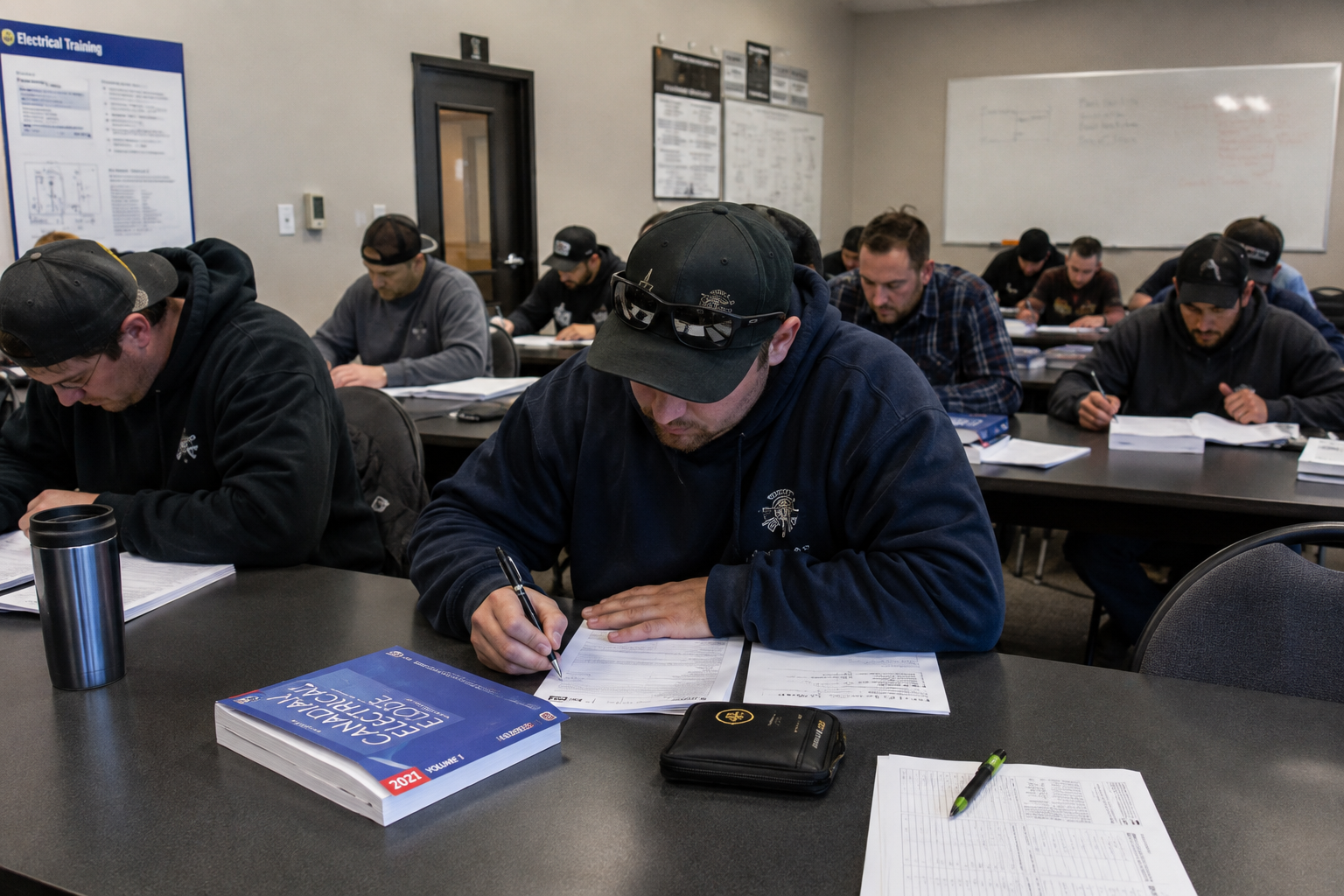
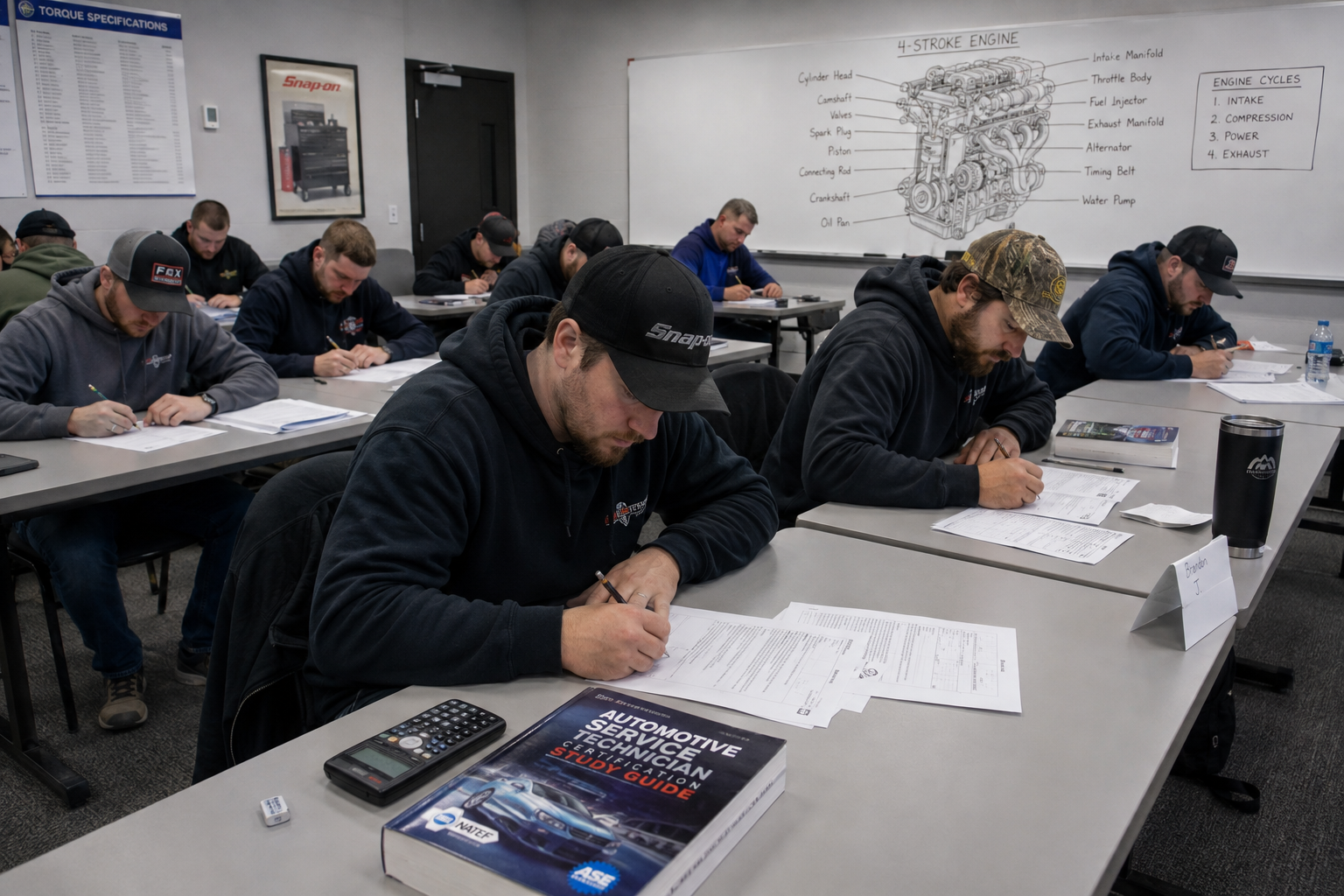
Four hours of sustained concentration is its own skill. Sit at least three complete 125 question mocks under real conditions, closed book, no phone, one sitting. Review every wrong answer before you attempt the next one, and note whether you missed it on knowledge or on reasoning. Those two failures need different fixes.
Space your review
Torque sequences, electrical formulas, system operating principles and terminology hold better when revisited at increasing intervals over several weeks than when crammed in the final fortnight.
Red Seal Automotive Service Technician Exam Preparation Checklist
-
Confirm your eligibility route and hour requirements with your provincial apprenticeship authority
-
Download the Red Seal Occupational Standard and Trade Profile for Automotive Service Technician
-
Complete the self assessment tool and record every gap it exposes
-
Check the current question distribution on the official exam information page
-
Book study time in proportion to the blueprint, not to what you enjoy
-
Complete a minimum of three full length timed mock exams of 125 questions
-
Review every incorrect answer and classify it as a knowledge gap or a reasoning gap
-
Give hybrid, EV and networking content dedicated sessions if your shop does not service them
-
Begin structured study eight to twelve weeks before your exam date
Red Seal Automotive Service Technician Practice Questions and Mock Exams
Practice volume separates candidates who pass comfortably from candidates who scrape or fail. Not because questions repeat, but because the reasoning pattern becomes automatic and stops consuming time you do not have.
Expect scenario questions. One might give you a no crank condition with specific voltage readings at the starter and ask which test comes next. Another might describe a network fault where three modules have dropped off the bus and ask what that pattern indicates. A third might present a hybrid vehicle service procedure and ask which step must come first.
The critical thinking questions are the ones that decide results. They typically hand you data, not a description, and ask what the data means. Practising them repeatedly is the only way to make that interpretation fast enough to fit inside two minutes.
Common Mistakes During Red Seal Exam Preparation
Studying the shop you work in. The exam covers the trade as practised across Canada. Diesel engine support systems, restraint systems and hybrid drive systems all appear whether or not your bay sees them.
Treating diagnosis as component knowledge. Sixty seven questions ask what you would do next. Knowing what a part does is not the same as knowing which test isolates it.
Skipping the exam information page. Candidates who never look at the published question distribution end up spending three weeks on engines, worth 22 questions, and three days on electrical, worth 23.
Trusting the wrong practice material. Several commercial prep sites publish blueprints for this trade that do not match the official one, including figures that are off by a factor of nearly two on some activities. Check any product's numbers against the Red Seal page before you pay for it.
Practising in short bursts only. Twenty questions on a phone during lunch builds knowledge. It does not build the stamina or pacing that a 125 question paper demands.
Leaving the electronics for last. It is the largest block on the exam and usually the least familiar. It needs the most time, not the leftover time.
How Hard Is the Red Seal Exam Compared With Provincial Exams?
The pass mark is identical. What changes is scope.
Your provincial level or period exams test the technical training you have just finished. The curriculum is defined, the material is recent, and the questions stay inside the level you sat. British Columbia apprentices write a standardized written exam after each of Levels 1, 2 and 3. Alberta apprentices write a provincial exam at the end of each period. Ontario apprentices work through three in school levels.
The Red Seal exam tests all of it at once, plus tasks your province or your employer may never have given you. It arrives months or years after your last classroom day. It is closed book. And it weights critical thinking at 40 to 50%, where level exams lean harder on recall of recently taught material.
So the honest comparison is this: the bar is the same 70%, the paper is not harder question by question, and the difficulty comes from breadth and from reasoning under time pressure. Technicians who fail rarely fail because a question was unfair. They fail because they prepared for the trade they practise rather than the trade the standard describes.
Free Resources for Red Seal Automotive Service Technician Exam Preparation
Red Seal Program: the occupational standard, the trade profile, the published exam breakdown, sample questions and the self assessment tool, all free to download.
Skilled Trades Ontario: 310S program requirements, Trade Equivalency Assessment, exam scheduling and fees.
SkilledTradesBC: program profile, challenge application requirements and the employer declaration of work experience form.
Tradesecrets Alberta: apprenticeship terms and the Trades Qualifier requirements.
Provincial apprenticeship offices are also the right source for local exam preparation workshops and current fees. Union and employer training centres often hold practice material for members.
Why the Ticket Is Worth the Work
Job Bank puts the national median wage for this occupation at $29.89 an hour, with the range running from $19.00 to $43.27, and 85% of workers receiving at least one non wage benefit. British Columbia leads the provinces at a $35.00 median. The Northwest Territories sits higher again at $42.00.
The demand side is stronger still. Industry projections point to a shortfall of roughly 30,000 technicians in Canada over the next five to six years, with about half of apprentices not completing their programs. Certified technicians who can diagnose modern systems are the scarcest part of that shortfall.
FAQ
How many questions are on the Red Seal Automotive Service Technician exam?
125 multiple choice questions, each with four options and one correct answer.
What score do you need to pass?
A minimum of 70%, the same threshold as every other Red Seal trade.
How long is the exam?
Four hours, which works out to roughly 1.9 minutes per question.
Does the exam cover electric and hybrid vehicles?
Yes. Nine questions cover hybrid and EV systems directly, and a further 12 cover vehicle module communications. Combined with electrical and comfort control, that is 44 questions.
Can I challenge the exam without an apprenticeship?
Yes, through your provincial authority. British Columbia requires 9,540 documented hours. Alberta requires 72 months and 9,180 hours. Ontario requires a Trade Equivalency Assessment against the full 7,220 hour program.
Is the Red Seal exam harder than my provincial level exams?
The pass mark is the same. The scope is much wider, since it covers the entire national standard rather than one level of technical training, and far more questions test reasoning than recall.
How long should I study?
Eight to twelve weeks of structured preparation suits most candidates. Add time if hybrid, EV or networking content is unfamiliar.
Is the exam the same in every province?
The content is national. Eligibility rules, fees, scheduling and retake waiting periods are set provincially and vary.