Provincial certification and the Red Seal are not two competing credentials: the first is the licence a province issues, and the second is a national stamp printed on that licence. Which one you need comes down to two facts: your trade and the province where you work. This guide compares six provinces: which trades are compulsory in each, where the Red Seal exam fits, and why a provincial certificate also counts in Express Entry. Every figure was checked against regulator websites in October 2026.
Main Takeaway
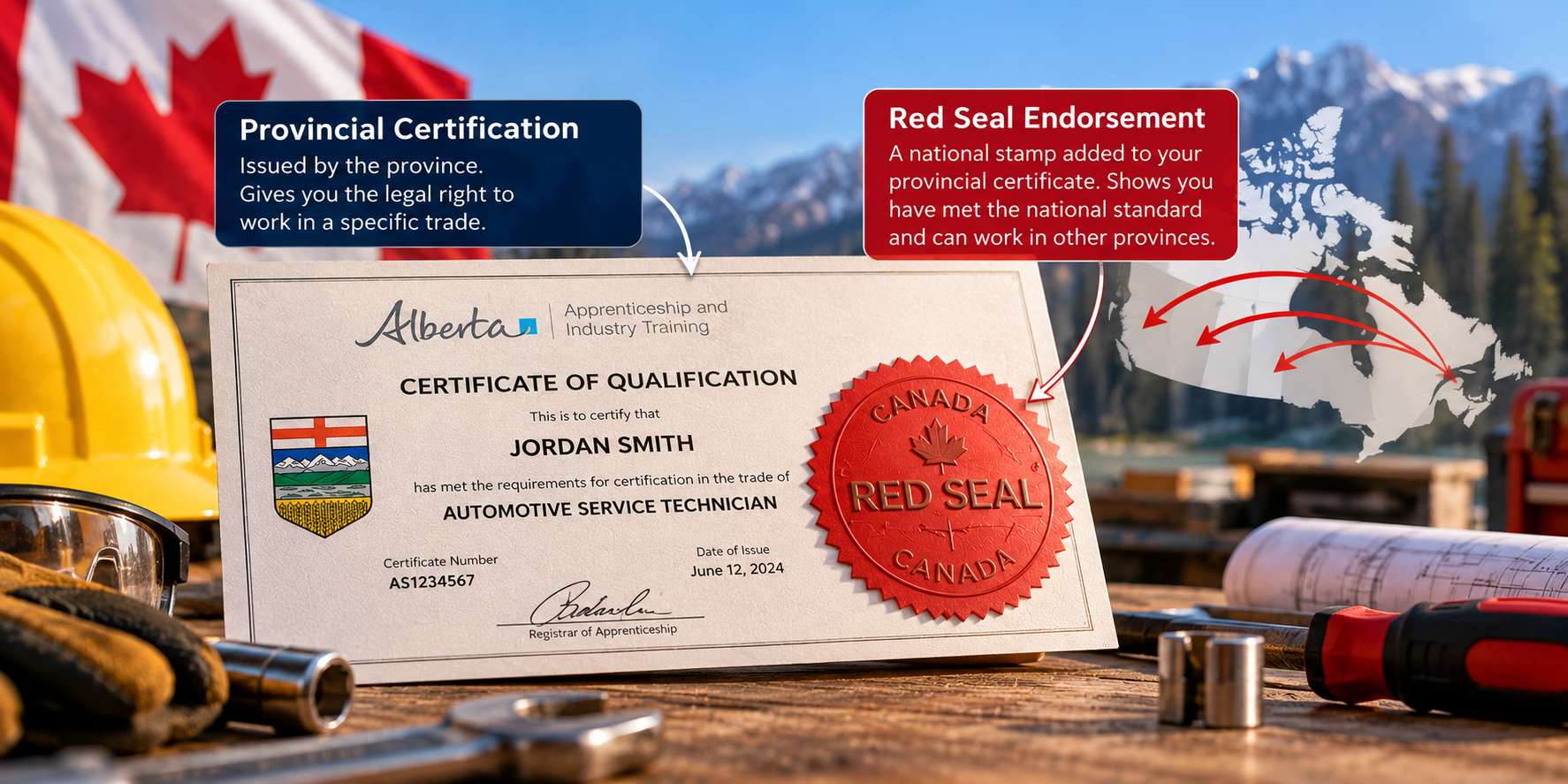
Provincial certification (a Certificate of Qualification) gives you the legal right to work a trade in one province. Red Seal is a national endorsement added to that certificate, letting it travel to other provinces without rewriting the exam. Which one you need, and whether it is mandatory, depends on your trade and your province.
Key Takeaways
- A provincial certificate, called a C of Q in most provinces, is your legal right to work; the Red Seal is a national endorsement earned by passing one more exam.
- Compulsory trades are a minority: 23 of 144 in Ontario, 7 in BC since December 2023, 19 in Alberta, 9 in Manitoba and 5 in Saskatchewan.
- Quebec runs a parallel system: construction trades certify through the CCQ, and the Red Seal is known there by its French name, the Sceau rouge.
- In Ontario and Manitoba, the certification exam in a Red Seal trade is the Red Seal exam, while Alberta apprentices write it after meeting provincial requirements.
- A provincial or territorial certificate earns up to 50 Comprehensive Ranking System points in Express Entry when paired with strong language test results.
The Core Difference Between Provincial Certification and Red Seal
A Certificate of Qualification (CoQ), which most regulators write as C of Q, is the document that gives you the legal right to work a specific trade in a specific province or territory. Red Seal is the national endorsement added on top of it. The provincial or territorial apprenticeship authority issues the certificate, while the Red Seal Program sets a national standard for each Red Seal trade and an interprovincial exam to test it.
What the Red Seal is not matters just as much. It is not a separate licence; it does not replace the provincial certificate, and it has nothing to attach to without one. Alberta's apprenticeship authority describes Red Seal holders as tradespeople who hold a trade certificate with a Red Seal, which is exactly how the system works: the seal rides on the certificate.
In a compulsory trade, you must be a registered apprentice or a certified journeyperson to do the work legally. In a voluntary trade, anyone can do the work, and certification is a career decision rather than a legal requirement. The same trade can be compulsory in one province and voluntary in the next.
Is a Certificate of Qualification the Same as a Red Seal?
No. A Red Seal is always attached to a provincial or territorial certificate; it never stands in for one. In plain terms, the Red Seal endorsement means that you met your province's requirements and also passed the interprovincial exam built on the national standard.
The confusion comes from everyday speech. Tradespeople say "I have my Red Seal" when they mean their journeyperson ticket with the seal printed on it, and job postings often treat the two phrases as interchangeable. Not every trade has a Red Seal, either. An Ontario journeyperson in a provincial trade holds a valid C of Q with no endorsement available to add.
Ontario: 23 Compulsory Trades Out of 144
Ontario recognizes 144 trades, and 23 of them are compulsory, including plumber, electrician, steamfitter, and hairstylist. The regulator is Skilled Trades Ontario (STO), a Crown agency that replaced the Ontario College of Trades in January 2022 under the Building Opportunities in the Skilled Trades Act, 2021.
The certificate of qualification Ontario issues is the C of Q. To work in a compulsory trade, you must hold a valid C of Q, a provisional certificate of qualification or a registered training agreement. Since April 1, 2024, every C of Q in a compulsory trade must be renewed each year or it expires.
When you complete an apprenticeship in a trade with a certifying exam, STO automatically issues a ** one-year Provisional Certificate of Qualification**, which keeps you legal on site in a compulsory trade while you prepare for the exam.
In Ontario's Red Seal trades, the certifying exam is the interprovincial Red Seal exam, so most apprentices write it by default and receive the endorsement with their first C of Q. For routes, fees and booking steps, see our full guide to earning the Red Seal in Ontario.
Quebec: A Parallel System With the CCQ and the Sceau Rouge
Quebec runs two certification tracks side by side. Construction trades fall under the Commission de la construction du Québec (CCQ), which issues a certificat de compétence compagnon, the journeyperson competency certificate. A CCQ apprenticeship runs from one to five periods of 2,000 hours each, depending on the trade, and ends with a qualification exam. Certain regulated trades outside construction are certified by the provincial ministry of labour and employment (MTESS), which issues its own certificate of qualification.
The Red Seal exists in Quebec under its French name, the Sceau rouge. According to the Government of Quebec, holders of a CCQ or ministry certificate can apply to write the Sceau rouge exam, and the endorsement then appears on their certificate.
Mobility works differently than many workers expect. Quebec notes that under the Canadian Free Trade Agreement, certified workers in a regulated trade can work in another province with or without the Sceau rouge, but they still go through that province's recognition process. Take two CCQ journeypersons moving to Ontario. The plumber benefits from an exemption STO lists for valid Quebec certificates in seven compulsory trades. The carpenter has no such exemption and must apply to STO to have the Quebec credential verified before receiving an Ontario C of Q. The Sceau rouge sidesteps much of that uncertainty, because it proves the worker meets the common Canadian standard every participating jurisdiction already recognizes.
British Columbia: Compulsory Certification Returns
British Columbia reinstated compulsory trades in December 2023, after roughly two decades as the only province without them. The regulator is SkilledTradesBC, the Crown agency formerly known as the Industry Training Authority. Under its Skilled Trades Certification system, seven trades are compulsory. They are Construction Electrician, Industrial Electrician, Powerline Technician, Steamfitter/Pipefitter, Refrigeration and Air Conditioning Mechanic, Gasfitter Class A and Class B, and Sheet Metal Worker.
The list is growing. In July 2026, SkilledTradesBC announced Mobile Crane Operator and Tower Crane Operator as the next compulsory trades, with requirements taking effect on July 5, 2027.
The certificate of qualification BC issues in these trades comes either with a Red Seal endorsement or as a provincial C of Q. A C of Q from another province or territory, or a Red Seal in the same trade, already meets the requirement. Gasfitters deal with two regulators: SkilledTradesBC issues the C of Q with Red Seal, and Technical Safety BC issues a separate gas certificate after an exam on the Acts, Regulations and Directives that govern gas work in BC.
If you worked in one of these trades in BC before December 2023 without registering, check your current status. Today, every worker in a compulsory trade must be a registered apprentice, a registered trade qualifier or a certified journeyperson.
Alberta: Journeyperson Certificates and Restricted Activities
Alberta's regulator is Apprenticeship and Industry Training (AIT), and its public site, Tradesecrets, lists more than 50 designated trades. In practice, the certificate of qualification Alberta issues after apprenticeship is called the Alberta Journeyperson Certificate; AIT also issues Qualification Certificates and Occupational Certificates.
Alberta builds compulsion around restricted activities, the specific tasks only qualified people may perform. By our count of the Tradesecrets list in October 2026, 19 trades require compulsory certification. Examples include Electrician, Plumber, Gasfitter, Heavy Equipment Technician, Crane and Hoisting Equipment Operator, Welder and Hairstylist. Counting branches, such as the four crane specialties, the list reaches 34 entries.
The Red Seal sits slightly apart here. Alberta apprentices in Red Seal trades write the Red Seal exam after they complete all requirements for journeyperson certification, so a tradesperson can be certified without the endorsement. Trade qualifiers follow a different order: once AIT verifies their work experience and practical skills, the exam they schedule is the Red Seal exam. For the full process, read our step-by-step Alberta Red Seal guide.
Manitoba: Nine Compulsory Trades and One Combined Exam
Apprenticeship Manitoba designates more than 50 trades, and nine require compulsory certification. They are Construction Electrician, Industrial Electrician, Crane Operator (mobile, boom truck hoist and tower), Refrigeration and Air Conditioning Mechanic, Sprinkler Fitter, Steamfitter/Pipefitter, Electrologist, Esthetician and Hairstylist. Every other designated trade is voluntary, so you can work in it without being an apprentice or journeyperson.
The certificate of qualification Manitoba issues depends on one final step. Apprentices and trade qualifiers alike must pass the certification exam for their trade with at least 70%, and in a Red Seal trade, that certification exam is the Red Seal exam. One pass therefore earns the provincial C of Q and the Red Seal endorsement together.
Credentials from elsewhere carry over: Manitoba recognizes a Red Seal in any trade and Canadian certification in its compulsory trades. As of October 2026, the trade qualifier certification exam costs $400, and a rewrite costs $100.
Saskatchewan: Five Compulsory Trades Under SATCC
The Saskatchewan Apprenticeship and Trade Certification Commission (SATCC) is an industry-led body at arm's length from government. It oversees more than 47 designated trades and subtrades. Only five are compulsory: Construction Electrician, Plumber, Refrigeration and Air Conditioning Mechanic, Sheet Metal Worker and Sprinkler Fitter. Sprinkler Fitter joined the list in January 2019, the first new compulsory designation in Saskatchewan since 1988. Every other trade is voluntary.
The credential SATCC issues is the Journeyperson Certificate of Qualification. Experienced workers with out-of-province or foreign experience can apply as trade qualifiers instead of completing an apprenticeship. For internationally trained workers in a compulsory trade, SATCC explains that once you are assessed and approved, your employer registers you and a special permit card lets you work before you write the interprovincial exam.
In welding, a growing number of Saskatchewan employers list the certificate as a hiring requirement even though the law does not; see why Saskatchewan employers increasingly ask for it.
Provincial Certification at a Glance
The table below sets the six systems side by side as of October 2026.
| Province | Regulator | Certificate | Compulsory trades | Where Red Seal fits |
|---|---|---|---|---|
| Ontario | Skilled Trades Ontario | C of Q | 23 of 144 | Certifying exam in Red Seal trades |
| Quebec | CCQ and MTESS | CCC or C of Q | Parallel system | Sceau rouge on the certificate |
| British Columbia | SkilledTradesBC | C of Q | 7, cranes from 2027 | Certification exam in Red Seal trades |
| Alberta | AIT | Journeyperson Certificate | 19 of 50+ | Written after provincial requirements |
| Manitoba | Apprenticeship Manitoba | C of Q | 9 of 50+ | Same exam as certification |
| Saskatchewan | SATCC | Journeyperson C of Q | 5 of 47+ | Interprovincial journeyperson exam |
Compulsory lists are short everywhere, and only Alberta and Quebec regularly treat the endorsement as a separate step.
Common Mistakes When Choosing Between Provincial Certification and Red Seal
Assuming Red Seal replaces your provincial certificate. It does not. The seal is printed on the C of Q, so if the certificate lapses, the endorsement gives you no right to work. An Ontario journeyperson in a compulsory trade who skips the annual renewal no longer holds a valid certificate, Red Seal or not.
Assuming a trade is compulsory everywhere because it is compulsory at home. Plumber is compulsory in Ontario, Alberta and Saskatchewan, but it is not on BC's list of seven or Manitoba's list of nine. A plumber moving from Saskatchewan to Manitoba goes from a compulsory trade to a voluntary one, and a BC plumber moving to Alberta goes the other way.
Not checking whether the Red Seal exam is bundled. In Ontario and Manitoba, the certification exam in a Red Seal trade already is the Red Seal exam, so no second application is needed. In Alberta, a journeyperson who did not earn the endorsement during training must file a separate application, with its own fee, to write it later.
Treating Quebec as an edge case. Quebec runs a full parallel system with its own regulators, certificate names and exams. Assuming a CCQ certificate behaves like an Ontario C of Q leads to surprises after a move, so check the recognition rules in the destination province first.
Why a Certificate of Qualification Also Matters for Express Entry
A certificate of qualification from a Canadian province or territory is a named factor in the Comprehensive Ranking System (CRS), the points grid Express Entry uses to rank candidates. According to IRCC, a certificate is worth 25 points with Canadian Language Benchmark (CLB) 5 or higher and at least one ability at CLB 5 or 6, and 50 points with CLB 7 or higher in all four abilities.
The certificate also counts before any points are awarded. The certificate of qualification Express Entry accepts under the Federal Skilled Trades Program can replace a valid job offer as a minimum eligibility requirement. Since IRCC removed CRS points for job offers on March 25, 2025, a tradesperson's certificate does two jobs at once: it opens the program and it adds points.
One practical catch: the Canadian Information Centre for International Credentials (CICIC) notes that provincial and territorial authorities are not set up to issue certificates to people outside Canada. In practice, the certificate is usually earned by workers already in Canada on a temporary basis. A licensed immigration professional can assess whether you qualify for a specific program.
Disclaimer: This article provides general information only and is not immigration or legal advice. Immigration rules, eligibility requirements, processing procedures, and government programs may change. For advice about your individual situation, consult a licensed Canadian immigration professional or lawyer and verify current requirements with Immigration, Refugees and Citizenship Canada (IRCC) or the relevant provincial authority.
What This Means for You
If your trade is voluntary in your province, the law does not require a certificate at all, so a provincial C of Q without the seal already exceeds the legal minimum. If your trade is compulsory, certification is mandatory, full stop: you must be a registered apprentice or a certified journeyperson to do the work.
Your next step is concrete. Before you apply for the Red Seal exam, check your trade's status on your provincial authority's website, because the same trade can be compulsory on one side of a border and voluntary on the other.
Your provincial certificate protects your right to work. Your Red Seal protects your right to work anywhere.
Frequently Asked Questions
How do I get a Canadian Certificate of Qualification?
You get one through the apprenticeship authority in your province or territory, by one of two routes. Apprentices complete their on-the-job hours and technical training, then pass the certification exam. Trade qualifiers document enough work experience to be approved to challenge the exam without an apprenticeship. Hours, fees and exam rules differ by jurisdiction, so start with the Ontario to Saskatchewan sections above.
Does my certificate still work if I move to another province?
Not automatically. Labour mobility rules usually let a certified worker have a certificate recognized in another province without a new exam, but you still apply to that province's authority, and some trades add local requirements, such as the separate gas exam in BC. A Red Seal makes the step simpler, because every participating jurisdiction already recognizes the national standard behind it.
What does "Certificate of Qualification" mean?
It is the official proof that a provincial, territorial or federal authority has assessed you and found you qualified as a journeyperson in one specific trade. IRCC notes that some authorities call it a "qualification certificate" instead. In Alberta, the usual name is Journeyperson Certificate, and in Quebec construction it is the certificat de compétence compagnon.
Where can I find the list of designated trades in my province?
Each regulator publishes its own list. For the certificate of qualification Ontario list, start with Skilled Trades Ontario's compulsory trades page. The other five are the CCQ, SkilledTradesBC, Tradesecrets, Apprenticeship Manitoba and SATCC.
Is a Certificate of Qualification the same as a Red Seal?
No. The C of Q is the provincial licence, and the Red Seal is an endorsement printed on it after you pass the interprovincial exam. You can hold a C of Q without a Red Seal, but not a Red Seal without a C of Q. The second section of this article explains why the two get mixed up.
Does a Certificate of Qualification count for Express Entry points?
Yes. A certificate from a Canadian province or territory adds 25 CRS points with CLB 5 or higher, and 50 points with CLB 7 or higher in all four language abilities. It can also replace a job offer for Federal Skilled Trades Program eligibility. This is general information rather than immigration advice, so confirm your situation with a licensed Canadian immigration professional or lawyer.
Sources Used
- Skilled Trades Ontario: Work in the Compulsory Trades and Provisional Certificate of Qualification
- Ontario Government: Compulsory Trades and Enforcement
- Commission de la construction du Québec: Certificat de compétence
- Government of Quebec: Sceau rouge and interprovincial mobility
- SkilledTradesBC: Skilled Trades Certification (Compulsory Trades)
- Tradesecrets (AIT): Compulsory Certification Trades and Red Seal Endorsement
- Apprenticeship Manitoba: Compulsory Trades and Certification Exams
- SATCC: Experienced Workers and FAQ for International Applicants
- IRCC: Federal Skilled Trades Program Eligibility and CRS Criteria
- Technical Safety BC: Class A Gas Fitter