To get Red Seal certification in Canada, you pass the interprovincial exam for your designated trade after a provincial or territorial apprenticeship authority confirms you meet the Red Seal certification requirements. Most tradespeople arrive at that exam through a registered apprenticeship. Others qualify on documented work experience alone.
There is no national application desk. The Red Seal Program Canada relies on is national in standard and provincial in administration, so every eligibility ruling, every fee, and every exam booking happens in the jurisdiction where you work. That one structural fact explains most of the confusion candidates run into, and it is where this guide starts.
What Red Seal Certification Actually Is
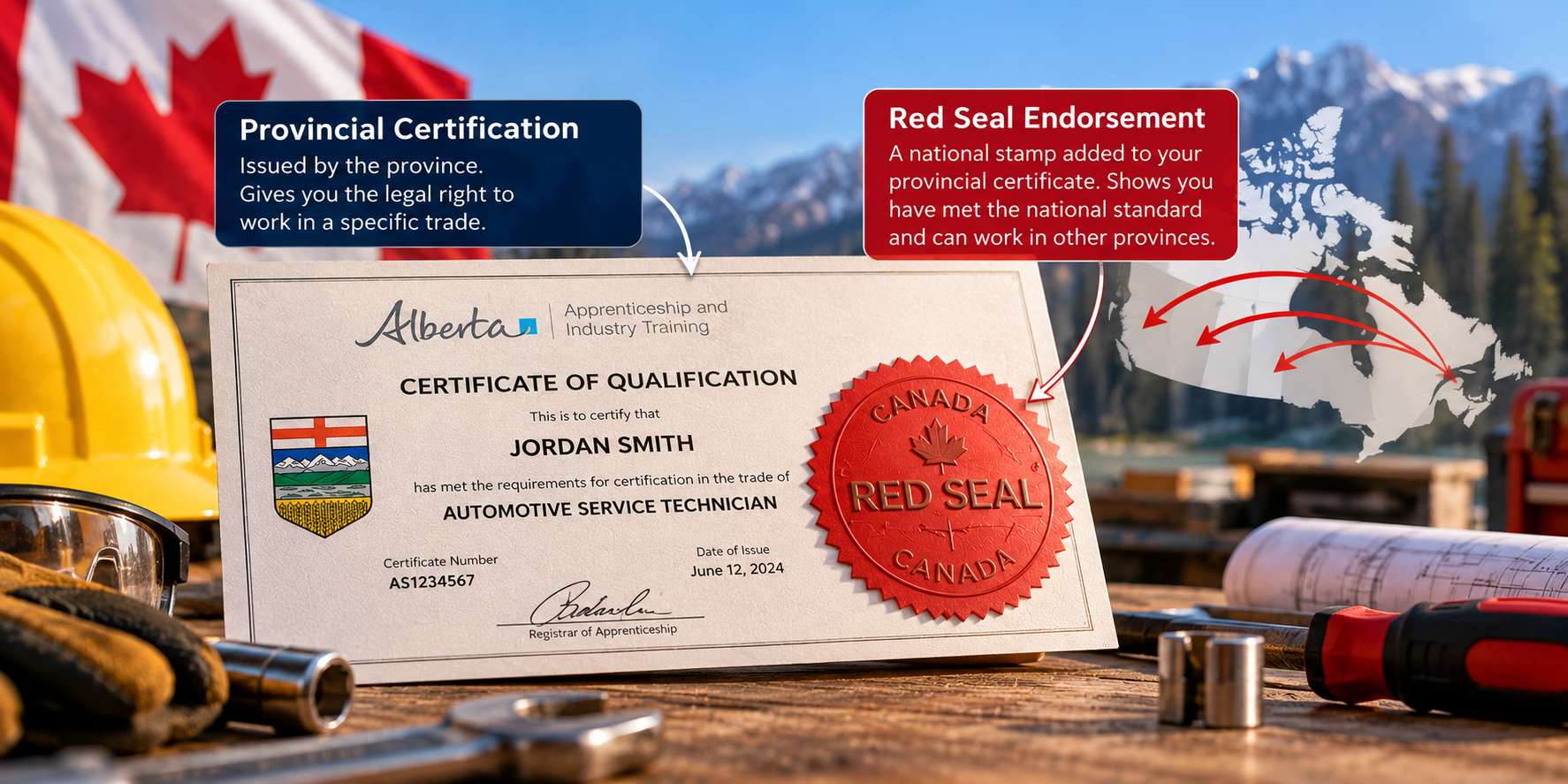
Red Seal certification is not a separate credential that replaces your provincial ticket. It is an endorsement applied to the trade certificate you already hold. You earn a Certificate of Qualification from your province or territory, and the Red Seal endorsement goes onto that certificate once you pass the national exam. The endorsement confirms one thing: you have demonstrated the knowledge required by the national standard for your trade.
The distinction matters in practice. A tradesperson without provincial certification cannot simply write the interprovincial exam and receive a standalone Red Seal certificate Canada-wide. The provincial credential comes first, or comes at the same moment, depending on how your jurisdiction sequences it.
Table 1: Red Seal Program at a Glance
| Factor | Detail |
|---|---|
| Official name | Interprovincial Standards Red Seal Program |
| Established | 1959 |
| Governing body | Canadian Council of Directors of Apprenticeship (CCDA) |
| Designated trades | 54 |
| What you receive | Red Seal endorsement on a provincial or territorial trade certificate |
| Recognition | All participating provinces and territories |
The Red Seal Program Canada launched in 1959 grew out of a national conference on apprenticeship held in Ottawa in 1952. Delegates there asked the federal government to work with provincial apprenticeship committees on common standards for the skilled trades. The program was created in 1959 and the CCDA has been responsible for it since.
In most jurisdictions the interprovincial exam has replaced the provincial certification exam entirely. That means finishing your apprenticeship program and earning the endorsement usually happen in the same sitting rather than as two separate events years apart.
The 54 Designated Red Seal Trades
There are 54 designated Red Seal trades on the official roster. Canada recognises more than 400 designated trades overall, so the Red Seal list is a deliberate subset: occupations where enough provinces and territories agreed the work is comparable across the country.
The list spans construction, transportation, manufacturing, service, and food sectors. Carpenter, Plumber, Welder, Steamfitter/Pipefitter, Construction Electrician, and Industrial Mechanic (Millwright) all carry the designation. So do Automotive Service Technician, Heavy Duty Equipment Technician, Cook, Baker, Hairstylist, and Landscape Horticulturist.
Two details trip people up. First, not every jurisdiction designates every trade: Alberta, for example, designates 39 of the 54. Second, some trades are split into separate credentials with separate occupational standards and separate exams. Construction Electrician and Industrial Electrician are two different Red Seal trades, and so are the three Ironworker specialisations.
Confirm your exact trade title on the official trades list before you buy a single study resource. Preparing against the wrong occupational standard is a costly error that surfaces late.
Red Seal Certification Requirements: Three Routes In
Which pathway applies to you depends on your training history and your province. The destination is identical; the paperwork is not.
Apprenticeship Completion
This is the standard route. You register with your provincial apprenticeship authority, work under a certified journeyperson, log the required hours, and complete each level of technical training. When your authority confirms you have met every requirement, you are cleared to write.
Hour requirements sit in the range of 6,000 to 9,000 hours for most trades, typically spread across three to five years. Technical training is usually delivered in blocks: several weeks in a classroom or shop, then back to the job site.
Trade Qualifier or Challenge Pathway
Experienced skilled workers who never registered as apprentices can apply to challenge the certification exam in most jurisdictions. Documented work experience replaces formal apprenticeship training. The usual threshold is 8,000 to 10,000 hours, though several trades and provinces set it at 9,000 specifically.
Authorities assess breadth, not just totals. A tradesperson whose entire history sits in one narrow area may be asked for additional experience or training before being cleared, because the exam covers the full national scope of the trade rather than one employer's niche.
Internationally Trained Tradespeople
If you trained and worked outside Canada, the challenge pathway is open to you after a credential assessment. Your provincial authority reviews your foreign qualifications and employment records against its own eligibility criteria, then decides whether you can write.
Documentation is the bottleneck here, not ability. Reference letters, employment records, and training transcripts translated into English or French move the file forward. Processing times vary considerably between jurisdictions, so start the assessment well before you plan to sit the exam.
Red Seal Canada Eligibility by Province and Territory
Red Seal Canada eligibility is determined provincially, which is why two tradespeople with similar backgrounds can get different answers depending on where they apply. Contact the authority that governs your jurisdiction.
Table 2: Provincial and Territorial Apprenticeship Authorities
| Jurisdiction | Authority |
|---|---|
| Ontario | Skilled Trades Ontario |
| British Columbia | SkilledTradesBC |
| Alberta | Alberta Apprenticeship and Industry Training |
| Saskatchewan | Saskatchewan Apprenticeship and Trade Certification Commission |
| Manitoba | Apprenticeship Manitoba |
| Nova Scotia | Nova Scotia Apprenticeship Agency |
| New Brunswick | Apprenticeship and Occupational Certification |
| Newfoundland and Labrador | Apprenticeship and Trades Certification Division |
| Quebec | Emploi Québec and, for construction trades, the CCQ |
Quebec deserves a separate note. The province runs its own certification system and participates in the program, but candidates there often face additional provincial steps before the interprovincial exam becomes available to them.
How to Apply for Red Seal Exam Approval
Knowing how to apply for Red Seal exam approval saves weeks of avoidable delay. The sequence is consistent across the country even though the forms differ.
- Confirm your trade is designated on the official Red Seal roster and in your province.
- Verify your eligibility category: apprentice, trade qualifier, or internationally trained applicant. Requirements differ by category and by trade.
- Gather documentation. Hour records, employer letters, technical training transcripts, and government issued photo identification.
- Submit the application to your provincial or territorial apprenticeship authority with the required fee.
- Request accommodations or a language preference in advance. Exams are available in English and French, and accommodation requests must be made well before the exam date.
- Book your sitting once approval comes through, then work backward from that date to build a study schedule.
Applications are reviewed by people, and incomplete files sit in queues. Send everything at once.
Red Seal Certification Exam Format and Requirements
The Red Seal certification exam is a written, closed book test of your knowledge across the full national scope of your trade. It is not a practical assessment, and it is not based on how your particular shop or site does things.
Table 3: Red Seal Exam Requirements and Format
| Factor | Detail |
|---|---|
| Format | Multiple choice, four options per question |
| Questions | 100 to 150, averaging around 125 |
| Correct answers | One per question, each worth one mark |
| Time limit | Maximum four hours |
| Pass mark | 70% |
| Languages | English and French |
| Basis | Red Seal Occupational Standard for your trade |
Every question is drawn from the Red Seal Occupational Standard, the document that breaks your trade into major work activities, tasks, and sub tasks. A sub task becomes testable only when at least 70% of provinces and territories confirm journeypersons in that trade perform it. That is the Common Core, and it is the boundary of what the exam can ask.
This is the single most useful thing to understand about exam preparation. The occupational standard for your trade is published free, it lists exactly what is testable, and the accompanying exam preparation guide shows how questions are distributed across activity areas. Study time should follow that distribution rather than your own comfort level.
Questions are situational. You are given a set of conditions and asked which action, calculation, or diagnostic step is correct. Passing the exam depends on applying trade knowledge under time pressure, not on recalling isolated facts.
Red Seal Certification Cost
Red Seal certification cost varies by jurisdiction because provinces and territories set their own fees. The official program does not publish a single national price; your authority quotes the amount when you register.
As a working range, exam fees commonly fall between roughly $100 and $500, with challenge and trade qualifier applications generally costing more than an apprentice sitting. Some jurisdictions charge nothing for certain level exams. Rewrites may carry their own fee, and several provinces impose a waiting period before you can rebook.
Budget beyond the exam itself. Study guides, code books, practice materials, and time away from paid work all factor in. Registered apprentices should also check current federal and provincial supports: Canada Apprentice Loans provide interest free borrowing during technical training, and provincial tax credits exist in several jurisdictions.
Can You Get Red Seal Certification Online?
Not entirely. The exam is written under supervision at an approved location, typically a testing centre, an apprenticeship office, or a government service office, depending on your province. There is no route to full Red Seal certification online, and any provider claiming otherwise is misrepresenting how the program works.
What can happen online is most of the surrounding process. Applications, credential submissions, fee payment, and result delivery are handled through provincial portals in most jurisdictions. Exam preparation is almost entirely online now, and that is where candidates have the most choice.
Preparing to Pass
Preparation separates candidates who hold years of solid experience from candidates who pass. These are not the same group, and the gap surprises people.
Start with the occupational standard. Download it for your trade and work through it task by task. Anything you cannot explain clearly in your own words is a gap. This document is free and it is the closest thing to an exam blueprint that exists.
Practise under time pressure. Reading generates recognition; answering questions generates retrieval. Retrieval is what the exam measures. Work through practice questions written against the current occupational standard for your specific trade, not generic material for the broader sector.
Complete three or four timed mock exams. Four hours of sustained concentration across 125 questions is a distinct cognitive demand, and candidates who have never rehearsed it discover their pacing problem on the day it counts. Roughly 30 questions per hour keeps you comfortable. Review every incorrect answer before moving on; understanding why the right answer is right is what shifts your score.
Give weak areas disproportionate time. A 70% threshold across all activity areas means strength in familiar territory will not offset weakness elsewhere. Mock exam results tell you where to look.
Use spaced repetition for anything numerical. Formulas, specifications, code references, and tolerances hold better when revisited at widening intervals over weeks than when crammed in the final days.
Platforms built for Canadian trades, including WorkUgo, provide practice questions and mock exams mapped to current occupational standards, which removes the guesswork of judging whether third party material still reflects the exam.
Eight to twelve weeks of structured preparation suits most candidates. Those crossing into a trade outside their daily work should plan for more.
How Long the Whole Process Takes
For an apprentice, the timeline runs three to five years from registration to endorsement, governed by hour requirements and technical training blocks. For a trade qualifier with the hours already logged, the limiting factors are application processing and your own preparation, so six months is realistic.
Internationally trained applicants should add time for credential assessment. Six to eighteen months from first contact to certification is a reasonable expectation, and the variable is almost always documentation rather than competence.
What the Endorsement Is Worth
Interprovincial mobility is the headline benefit. A certified tradesperson holding the endorsement can work anywhere in the country without recertifying. That matters enormously in sectors where work follows projects: oil and gas, mining, heavy construction, and industrial maintenance.
Red Seal Canada recognition also functions as a hiring filter. Supervisory and foreman postings increasingly list it as a requirement, employers use it as a reliable signal of competence, and it supports federal immigration streams for skilled trades applicants. Wage premiums vary by trade and region, but the pattern across the country is consistent enough that the exam fee is recovered quickly.
Common Mistakes
Preparing against the wrong trade standard. Related trades have separate standards and separate exams. Check the exact title first.
Assuming experience is preparation. The exam covers the national scope of the trade, including tasks your employer may never perform. Years on the tools cover part of the standard, rarely all of it.
Using outdated materials. Occupational standards and code books are revised on cycles. A guide referencing a superseded edition introduces errors into your preparation.
Leaving the application to the last minute. Approval takes time, and credential assessments take longer. Apply before you feel ready to write.
Skipping timed practice. Time management failures are entirely preventable and account for a meaningful share of near misses.
FAQ
How to get your Red Seal if you never did an apprenticeship?
Apply to your provincial apprenticeship authority as a trade qualifier. You will need to document 8,000 to 10,000 hours of relevant work experience covering the full scope of the trade, then pass the same interprovincial exam apprentices write.
How to get a Red Seal certificate in Canada as a foreign trained tradesperson?
Contact the apprenticeship authority in the province where you intend to work and request a credential assessment. Once your training and employment history are accepted, you apply to challenge the exam through the same process as any other trade qualifier.
How many questions are on the exam?
Between 100 and 150 multiple choice questions depending on the trade, with an average near 125. Each has four options and one correct answer.
What score do you need?
A minimum of 70%.
Is the exam identical in every province?
The content is standardised nationally. Eligibility rules, fees, scheduling, and administration are set provincially and genuinely differ.
What happens if I fail?
Your results identify the activity areas where you lost marks. Most jurisdictions impose a waiting period, commonly 30 to 90 days, before a rewrite, and some charge a fee. Use the score report to target your second attempt.
Do I need the endorsement to work in my trade?
Not usually. Provincial certification governs the legal right to work, and compulsory trade rules vary by jurisdiction. The endorsement adds national recognition and portability on top of that.
How long should I study?
Eight to twelve weeks of structured preparation is appropriate for most candidates, extended where there are gaps in specific activity areas.